Why Marion Grasby advocates using the wok for everyday cooking
Marion Grasby defends the wok as a versatile tool for fast cooking, from stir-fries to steaming, smoking and slow cooking.
For Marion Grasby, the wok is much more than a utensil: she describes it as an extra ingredient, because the patina that forms with use adds layers of smoky flavor and character to everything it touches. It responds very well to heat, allowing for quick and precise cooking, and is, according to her, the best everyday tool.
The wok is good for much more than stir-frying. According to Grasby, you can steam meatballs, fish, chicken, delicate custards, and even mashed potatoes and beets. It's also great for frying chicken, prawn toast, fish, pancakes, eggs, calamari, and even ice cream; for smoking duck, chicken, eggs, tofu, and some cheeses like feta; for grilling prawns, sausages, cherry tomatoes, cauliflower, cabbage, broccoli, peppers, mushrooms, and corn; and for simmering creamy fillings, soups, broths, and curry sauces.
Grasby prefers a flat-bottomed wok because a round one doesn't fit well on most home stovetops. He likes a top diameter of about 37 cm (14 1/2 inches) and a base of about 14 cm (5 1/2 inches), which provides a large central area for searing. The ideal thickness, 1.5 to 2 mm (1/16 inch), makes for a lightweight wok that heats up and cools down more quickly.
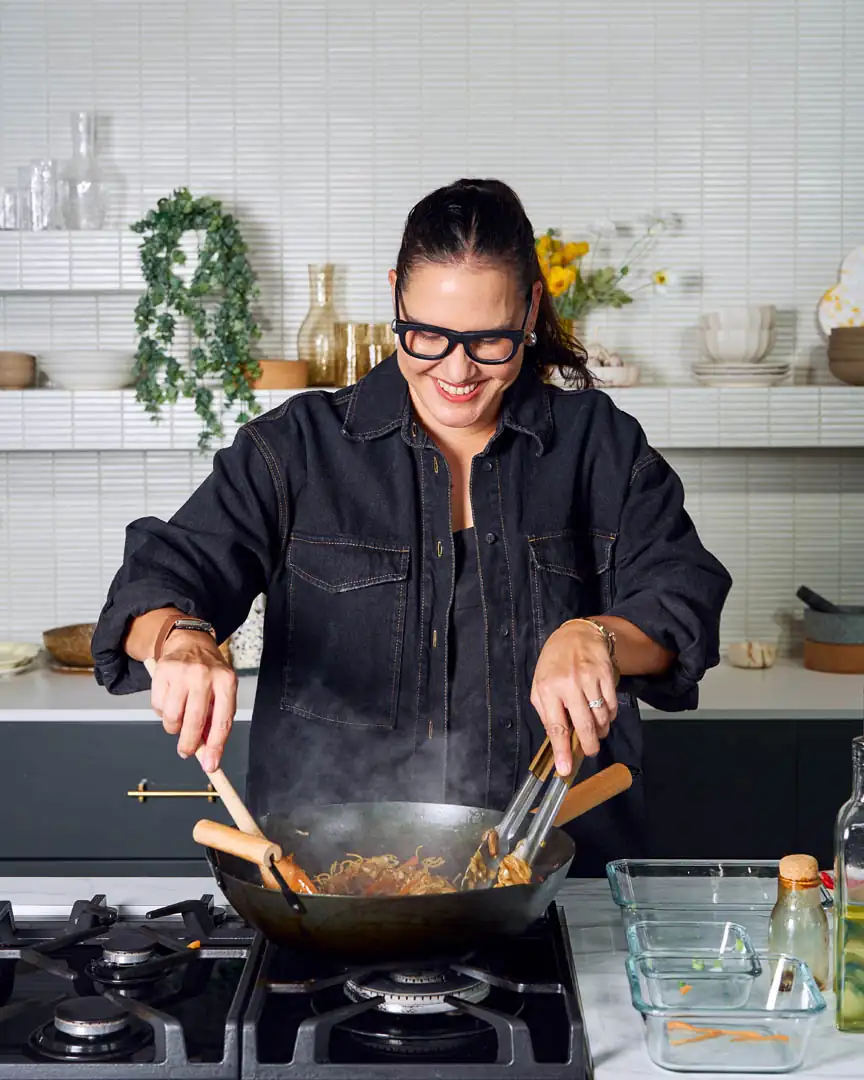
A long handle with an auxiliary grip makes it safer to handle when full and heavy. According to Grasby, the ideal wok is made of pre-seasoned carbon steel: it heats up and cools down quickly, is lightweight and very durable, and won't rust because it's already seasoned. With use, the patina builds up, imparting deep, smoky flavors.
Other materials have limitations. Cast iron allows for perfect searing, but it's very heavy; stainless steel requires thorough cleaning after each use and doesn't develop a patina; and non-stick coatings don't reach high enough temperatures for proper wok cooking.







