A gourmet haven for bean lovers
Roberto Ruiz Aguinaga (Beasain, 57) is the cook who knows the most about beans in the world. The Mr. Bean of Tolosaldea, or Mr. Bean, as my daughter Andrea called Rowan Atkinson's character. And that's no small feat, Mr. Babarruna.
Roberto Ruiz Aguinaga (Beasain, 57) is the cook who knows the most about beans in the world. The Mr. Bean of Tolosaldea, or Mr. Bean, as my daughter Andrea called Rowan Atkinson's character. And that's no small feat, Mr. Babarruna. I'm sure Roberto Ruiz is also the person who has tasted the most black beans in the Basque Country. Let me explain: In 1993, at just 23 years old, he took over the Café Frontón in Tolosa, the place where locals mingled with the unique and cultured "paper aristocracy" linked to one of the region's main industries. Well-traveled and cultured families, with accomplished chefs on staff, and cosmopolitan tastes.
Earning a reputation in that environment was no easy task. Moreover, it was entrusted to an outsider (from Beasain, "like Arguiñano") who strapped on his apron tightly and gave it his all until, 25 years later, he became (almost) indispensable and a symbol of Basque cuisine. (Respected and loved by his colleagues as well, which is like squaring the circle).
Well, Roberto Ruiz was determined to select and resurrect for haute cuisine that humble and comforting dish of black seeds, the rosary beads of Basque cuisine.
In 1993, Ruiz, along with technician Martín Mantxo, took on the challenge of cooking the 2,000 varieties of Tolosa beans that grew scattered across the farmhouses. Every Thursday, for two years, he cooked 20 different types each morning with water, salt, and time, then tasted them with spoons under the watchful eyes of forensic experts. They selected the best: today there are two varieties (haundia and txikia) and 40,000 kilos of production, sold at €15/kg through the association supported by the Eusko Label; this year they are already impossible to find.
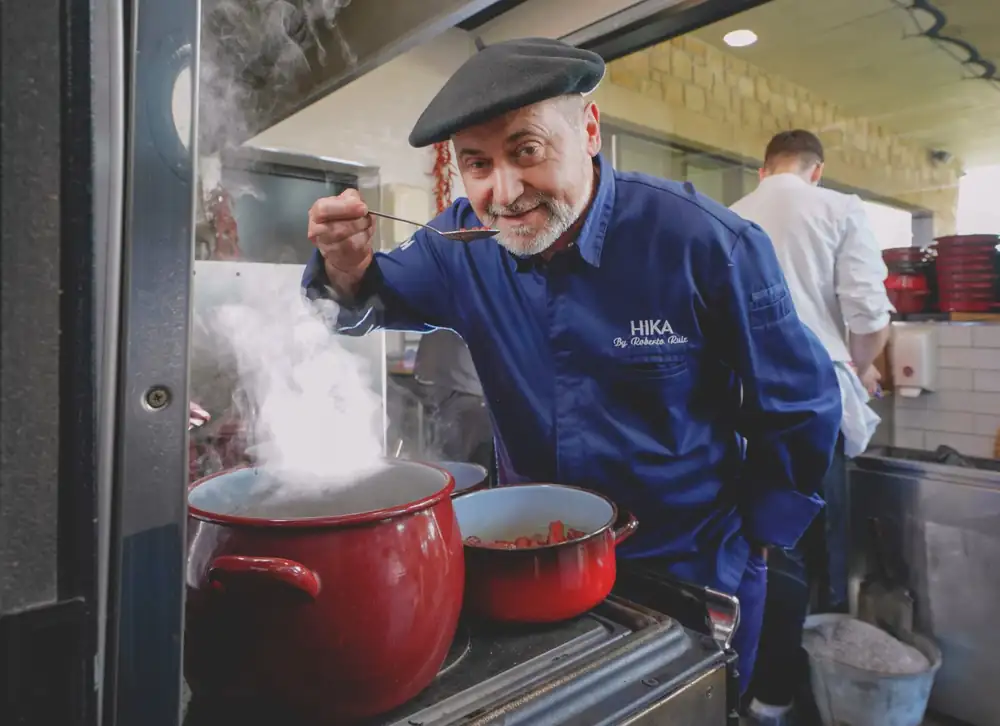
We chatted with Roberto Ruiz at Hika, the Amasa-Villabona winery, where he and his team, in partnership, run the restaurant. It's striking that, alongside chefs like Javi González, he's joined by veteran waitresses, with nearly 30 years of experience working with Ruiz, such as Ana Etxeberria and Mila Ugartemendia, pure wisdom in the ways and means of serving customers, which certainly reflects a way of being in the world. Red glazed earthenware pots from San Ignacio (known as Porcelanas to locals in Vitoria), along with breathtaking views of the region, welcome visitors. Roberto shows me the coal stove (a Vulcano from Lacunza) where the beans are slowly boiled and the accompaniment of cabbage from the garden, very fine bacon from Basque pied pigs from Maskarada, black pudding from Olano de Beasain, rib of latxa and lukainka sheep, pre-Columbian txistorra is cooked.
The magic formula for light beans
This chef, with his beret and denim jacket, is responsible for modernizing and refining the traditional Basque bean stew. "We make them without soaking them beforehand, from cold, and always on their own. That was very innovative. We also removed the accompaniments from the stew; they're cooked separately and served independently," he emphasizes, referring to the iconic Basque stew. "We're not alone. There's the Morán family from Asturias, the Maher's 'parrocas' beans in Cintruénigo, the Hispania beans, the Anguiano beans made by Francis... In Álava, with the local beans, they've focused more on production, and the Gernika bean is currently in a precarious situation," he summarizes.
Roberto tells me about his origins, the son of a worker born in San Martín de Valvení (Valladolid) and a mother from Viana, Navarre. "Mine was a simple childhood, spent outdoors, with controlled risk, the kind that shapes your personality. Just as my character was shaped by going to hunt pigeons and thrushes or fishing with my father for trout using worms (he was a two-time Gipuzkoa champion) in the Araxes River, near the Insalus spring."
It was cheaper than using a spoon and a fly. I also went out to the mountains on Sundays with the Mountaineering Society; I know all the mountains in the Basque Country. We'd go after frogs or crayfish, which we caught with a net and bait made from spoiled fish. Everything we caught and hunted was cooked by Lucio, my father, at the Aitz-Zorrotz Hunting and Fishing Society” he says. Ruiz smiles as he recalls his friend José Juan Castillo (who compiled recipes with catfish and water voles) when he recounts a peculiar dinner. There were hares, but so many people ended up gathering that they ended up cooking the fox they had shot that day. “In the end, nobody could tell that night whether they had eaten hare or fox. Or who was more of a fox, the one who cooked or the one in the pot” he laughs.
Roberto tells me that all the Ruiz family members have been good footballers and that he's the nephew of the legendary Primi (a player for the Glorious Ones who ran Bar Bujanda). "When he died, Di Stéfano sent a telegram of condolence to Uncle Primi's family, saying that he was the player who had most influenced him in his career. Football saved my uncle Aristeo's life, the one they called 'The Old Man': he fought for the Republican side and then ended up in concentration camps. A captain saw him play and protected him, taking him along to his postings: Alicante, Algeciras, Gran Canaria..."
It was the way he saw his father serving and participating in society that led him to study at the School of Hospitality (now Cebanc). "I was a seven-year-old, a top student." Alfonso and Rufino, his teachers, taught him the skills of a good cook. "To cook with precision and efficiency; also, the deference they instilled in us. It was a very hierarchical job, with complex relationships. You had to strive to advance and stop doing the hardest jobs," he confides. And during the year he spent at Bodegón Alejandro, the restaurant with 21 steps owned by Martín Berasategui's family ("it was like entering the catacombs"), he learned the value of "sacrifice" and the fusion of popular tradition with French refinement. And he discovered cuisine as a culture born from the land and its workers. "Culture comes from cultivating," he summarizes. "The first thing is the customer's trust, that 'give me whatever you want because I trust you.'" With fixed tasting menus, it's "you don't choose anymore, I'll do it for you." I defend à la carte dining. And different opening hours: with these closures, we've done away with the best part of restaurants, which was always the after-dinner conversation.
Of his 25 years at the Frontón de Tolosa, he recalls two moments. The first was the day Rafael García Santos showed him the path he follows, telling him, "If you're not going to be a great cook, specialize. Yours are the best beans I've ever eaten. I'm in the temple of beans!" The second was the morning a waitress called him on her way to the Café Frontón, telling him that gunshots had been heard downstairs. "I learned that Juan Mari Jáuregui had been killed; an affable, kind, and open person, and a great advocate for us, he always brought people to eat at our place," he emphasizes. A common occurrence, since "people from out of town wanted to eat at the Frontón," and he encouraged the local foodies of Tolosa, a pearl of culture and diversity, which Ruiz speaks so highly of. "For the choral competition, for the 'txontxongillos' (puppets, a must-see at their museum), for the Nairobitarra's travels in this welcoming town, for the Norwegian, German, and French families connected to the paper mills and schools like the Jesuitinas, Sacramentinos, or the French schools; for the Berastegi ski jumping competition (!), for the bullfights, the Carnival… " he says while mulling over a recipe for snails, "a delicacy with its sauce, which only Manchurians used to eat," he says from the depths of his Basque mixed-race soul. "Humble people, like the people of Extremadura, who never spoke of their land. When I went there for the first time, I saw they had a treasure." Good people, Ruiz.
Address: Otelarre, 40 (Amasa-Villabona) Telephone: 943 652 941.