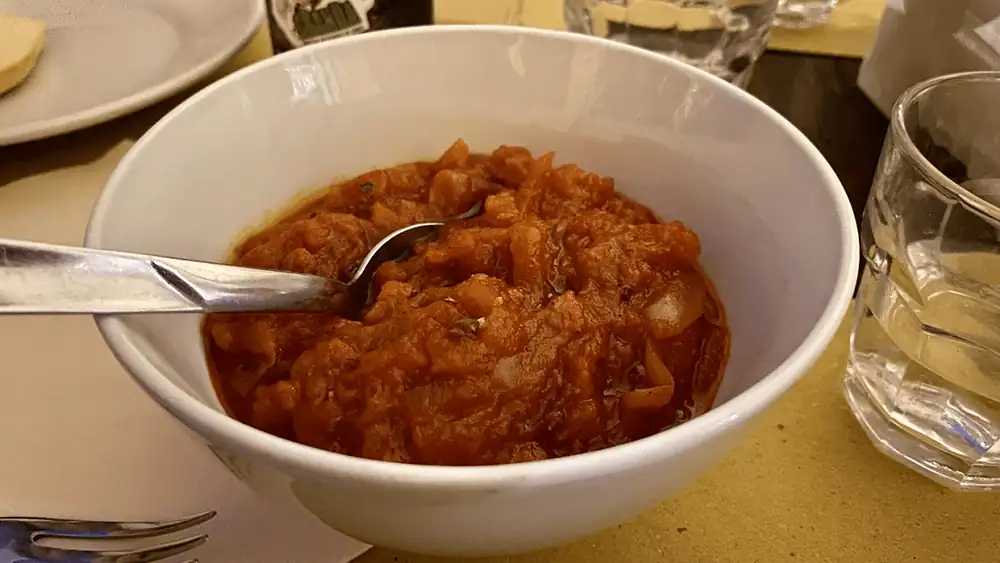
The kingdom of Medicina's friggione (and ragù)
Medicina is a charming (is that still the word?) municipality in the province of Bologna, about half an hour from the historic center and not usually the first destination people think of when planning a day trip.
This trattoria's cuisine is deeply rooted in the local area, drawing on most of its ingredients, along with the structure of its dishes and the distinctive Emilian flavors, yet staying away from any culinary stereotype. It's no easy task to offer excellent traditional cuisine, and Osteria di Medicina not only achieves this goal, but adds an extra layer of challenge by incorporating a personal vision into its dishes, while still remaining true to tradition. A sort of highly successful gastronomic oxymoron.
The atmosphere is what you'd expect from a classic trattoria, with paneled walls, wooden tables, and yellow paper placemats. In the summer, guests can dine under the umbrellas that span the entire width of the dead-end street, ensuring complete tranquility for their guests. Opposite the dining room is a small internal courtyard with the option of setting up a couple of tables in the most intimate corner of the restaurant.
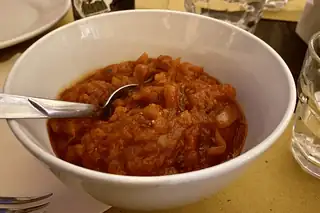
The menu is limited to a dozen dishes that vary throughout the year, but two are never missing: friggione and ragù. Served as an appetizer or as a condiment for first courses, these two specialties are the backbone of the trattoria and perfectly interpret the local area.
Friggione, for the few who don't know, is a sauce made entirely of onions (from Medicina, of course), tomato, oil, and, in this case, tiny diced gambuccio (a type of veal shank) and pepper. Perhaps it's the famous Medicina onion, perhaps it's the cooking method, perhaps it's some strange alchemy, but it's the best I've ever tasted: just the right amount of sweetness, creamy, fragrant, and slightly spicy. As an appetizer, it's served with tigella (a type of flatbread), while as a first course, it's aptly paired with spaghetti. The Osteria's signature dish is undoubtedly the green tagliatelle with ragù. In this case, the pasta gets its color from nettles, not the usual spinach—a variation with peasant origins that's rarely found today, whereas it used to be much more common. The advantage is that it gives the pasta a firmer texture and a different flavor than usual, very delicate yet equally noticeable. The ragù “della nonna Iole” is the real showpiece and has the particularity of using exclusively cuts of pork from the hybrid Mora Romagnola and Large White breeds from semi-wild farms that are flavored with onion, rather than the classic mirepoix, and tomato.
The whole thing is left to cook for 7 hours in the Fogacci pot, which uses a double chamber to maintain a constant temperature of 105°C (221°F). It's not the "traditional" Bolognese ragù, for all that that word makes sense, but a variation on the theme that explores different nuances while maintaining a time-honored flavor. Regulars might notice the classic aromatic bouquet of celery and carrot missing, but the overall result is convincing due to its rustic character, richness, and the character it lends to the dish. Add to that the portion is truly generous (around 200 grams of tagliatelle per serving), and you'll know where to go for tagliatelle next time. It's difficult to compare this dish to the same specialty offered by other restaurants because it's a competition in itself. That said, we're at the height of superlative excellence.
Among the other first courses, we were tempted by the "cold pasta, a little Japanese, a little Italian," consisting of small tagliatelle-style crepes, hard-boiled eggs, burrata cheese, and fava beans (lots of fava beans). The portions are generous, too, and it's a good, fresh vegetarian option. But we weren't thrilled with it, and perhaps it's a bit too daring, despite its refined taste and excellent flavor.
The main courses don't feature the great classics of Bolognese cuisine, and honestly, you won't miss them. You can choose between an excellent roast chicken, whose meat is firm and tender thanks to its perfect cooking, served with a French-inspired garlic mayonnaise and chopped giardiniera (almost like a sauce) (delicious). Alternatively, a wonderful slow-cooked pastrami served with a hearty tuna sauce flavored with onions and capers, a convincing reinterpretation of the flavors of classic vitello tonnato.
The most astonishing and also the ugliest second course—as Giorgione would say—is composed of a crescentina that's first fried, then baked and topped with mascarpone, a distinctly sweet onion sauce, and finished with fried beef meatballs. Let's be clear, reading the description on the menu, it wouldn't have been my first choice, and I must admit it's a somewhat absurd dish because it resembles nothing else, but it turns out to be a gluttonous delight of rare goodness and also reveals an undeniable balance of flavors and textures.
To finish, the lemon and calamint sorbet (the less aromatic type of mint traditionally used with Roman-style artichokes) is a perfect fit and quite elegant, thanks to the small gold leaf fragments it's decorated with. The purple fig sorbet with cream is also convincing, perhaps a little too conservative given the tone of everything else. If you really want to go all out, you can opt for the "I wanted to be a cheesecake," made with thick, fermented, whipped milk, an Osvego cookie crumble, and a topping that varies with the season: a fresh raspberry sauce.
A special mention also goes to the staff who advised us throughout the dinner, always courteous and attentive, which is not always a given. Osteria di Medicina is undoubtedly one of the most interesting trattorias in Bologna and its province for its professionalism, quality, and, last but not least, its excellent value.
Opinion
An excellent trattoria that successfully combines its own take on Emilian cuisine with a strict adherence to traditional standards. It strives to avoid stereotypes, and succeeds. The nettle tagliatelle with ragù are unmissable, and are worth the trip alone.
PRO
- Excellent value for money
AGAINST
- Some dishes are a little too daring.