Más de 800 olivos de todo el mundo se encuentran ahora en el mismo campo: el proyecto científico está en Gubbio
Estudiar plantas, catalogarlas, reunirlas, observarlas convivir en el mismo suelo. Lo hicieron en Umbría, no con cualquier planta, sino con olivos, seleccionando especies de 32 países diferentes. Se llama Domus Olear∑ y está ubicado en Gubbio. Es una iniciativa pionera en Italia, pero también a nivel internacional.
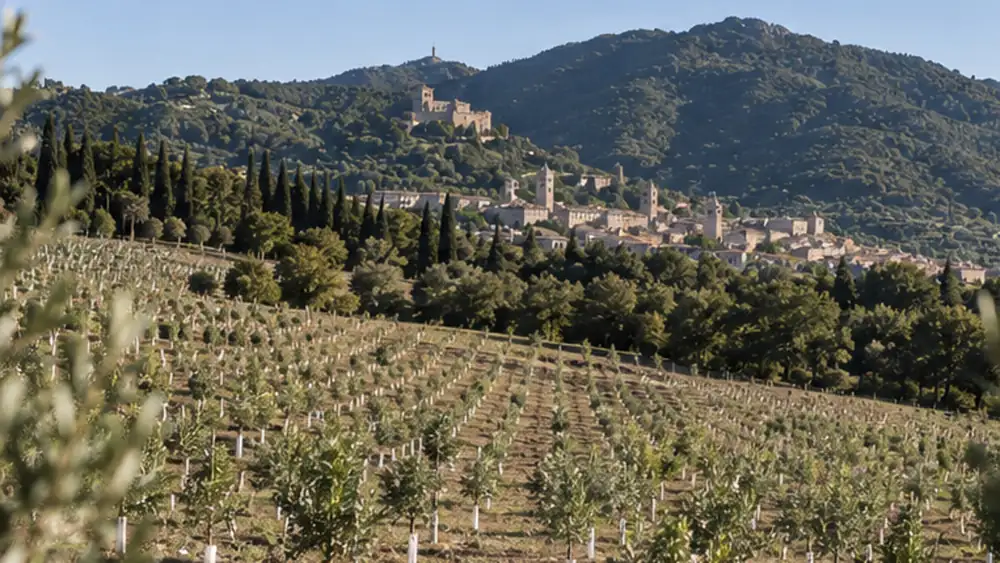
Studying plants, cataloging them, bringing them together, watching them live in the same soil. They did it in Umbria, not with just any plants, but with olive trees, selecting species from 32 different countries. It's called Domus Olear∑ and is located in Gubbio. It's a first for Italy, but it's also a first on the international scene. Domus represents the idea of finding a home for the centuries-old olive tree, while the symbol ∑ represents the sum of all the individual samples of living material collected, which will contribute, over time, to enriching this organic laboratory. Umbria, moreover, was not chosen by chance to host this international project, as it is a historic producer of olive oil and because the climate and soil conditions currently allow the coexistence of plants from very different contexts.
A living encyclopedia of olive trees in Gubbio
The initiative is promoted by the National Research Council, Institute of Biosciences and Bioresources (CNR-IBBR) together with the Di Murro Agricultural Company. Silvano Di Murro, the company's owner, has agreed to assume the responsibility of physically caring for this collection of trees, including overseeing their grafting, planting, and growth over time, a project that could span not just years, but generations. For this reason, the site will soon be available for tours and to disseminate information about what happens there, as well as about the olive tree in general, its history, and its genetic heritage.
A genetic heritage that is accessible as well as practicable
For non-technical people, this might seem like a difficult subject to grasp, but to explain it in rather accessible terms, approximately 10 hectares of land were taken in Montelovesco, near Gubbio, and 850 unique genotypes were planted: completely exclusive olive trees from 32 countries that have long cultivated this tree. To observe them in person, you would need to travel the world, or have access to servers that provide information on the trees, their history, and their genetics. Now this heritage is directly accessible, visible, and even walkable. Studies on olive oil are also proliferating around the world: just a few months ago, a library was inaugurated in Turkey, but it focuses on the olive oil, not the tree itself (we talked about it here).
Research, study, and resistance to the climate crisis for olive trees
The goal? Obviously, study and research on the plant, which will allow it to be cultivated in the future and made more resistant to disease and climate change. This is valuable on three levels. From an agricultural perspective, it is a necessary step in providing support and information to the companies that grow the plant. From a product perspective, the oil, it also allows us to study the elements that guarantee the production of superior-quality oils. Finally, it has international significance because the site plays a central role in international scientific cooperation (not just genetics) and is a bulwark of global food security, similar to seed banks, which here instead use plants whose genetics have been carefully studied.
The scientific process of the olive tree encyclopedia
It's no coincidence that behind every plant lies a molecular characterization effort conducted by the CNR-IBBR in Perugia, under the scientific direction of Soraya Mousavi and the technical direction of Roberto Mariotti, as part of the Omibreed project and with the support of the REACH-XY and Bexyl programs. This work has identified, among the more than 850 genotypes mentioned above, dozens of cases of varietal homonymy and synonymy, plants known by different names but essentially identical in botanical variety, or, conversely, the same names given to olive trees with different characteristics. This process will also enable collaboration with institutions and research centers around the world, as it is a living, carefully studied database.